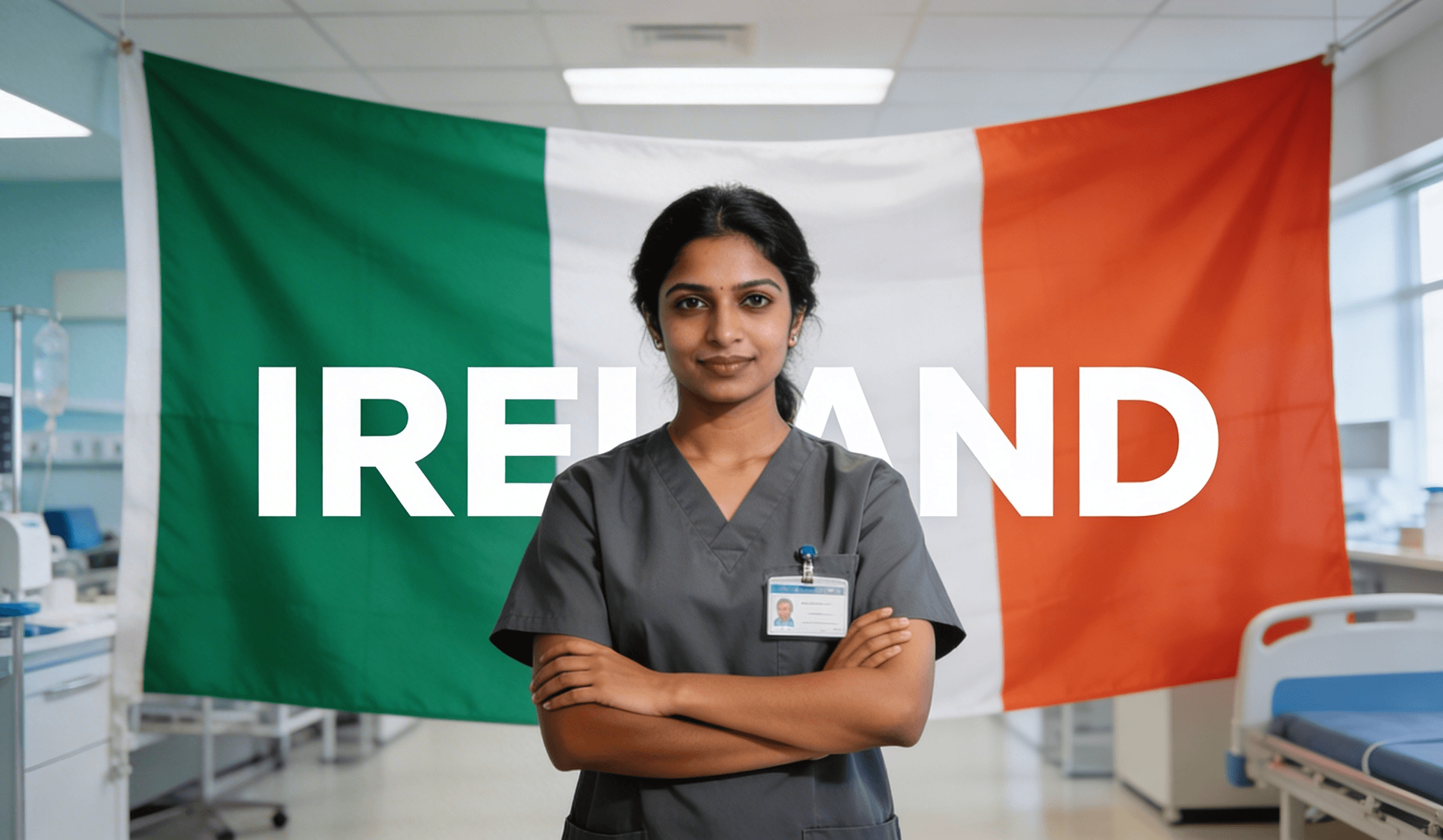
Ireland is one of the most underrated nursing destinations for Indian nurses. It has a chronic and well-documented nursing shortage — the Irish healthcare system (HSE) consistently struggles to fill nursing positions and actively recruits internationally. English is the sole language of Irish healthcare. The registration body (NMBI) does not require an OSCE. Salaries are strong by EU standards. And working in Ireland gives you EU residency — with the right to live and work across all 27 EU member states after achieving settled status.
Yet almost no Indian nursing agency or job site covers Ireland in detail. Most content stops at UAE, UK, and Canada. That gap is an opportunity: nurses who research Ireland properly and apply through a legitimate agency face significantly less competition than in UAE or UK pathways. This page covers everything — NMBI registration, the visa route, salary by grade, and why Ireland deserves to be on your shortlist alongside the more commonly discussed destinations.
NMBI Registration — The Straightforward Route Indian Nurses Do Not Know About
The Nursing and Midwifery Board of Ireland (NMBI) is the regulatory body for all nurses and midwives in Ireland. Unlike NMC (UK), NMBI does not require an OSCE — the practical clinical examination that costs £794 and requires travel to the UK. NMBI assesses internationally educated nurses through a competency-based framework that evaluates your qualifications and experience without a separate high-stakes practical examination.
This single difference makes NMBI registration considerably less stressful and expensive than NMC registration for Indian nurses. Total NMBI costs are approximately €600–800 (₹55,000–73,000) — roughly half the cost of UK NMC registration. And the process takes 3–6 months rather than 6–10 months.
NMBI Application Process
Submit your application to NMBI through the online portal (nmbi.ie). You will need: BSc Nursing degree certificate with official English translation if applicable, official transcripts, current Indian Nursing Council registration, Good Standing Certificate from INC, proof of English language proficiency (IELTS 7.0 Academic or OET B), two professional references from registered nurses or doctors, and a self-declaration of fitness to practice. NMBI Qualification Recognition Fee: €350 (plus €145 registration fee upon approval). Processing time: 8–14 weeks for initial assessment.
Competency Assessment — What NMBI Evaluates
NMBI assesses whether your Indian nursing qualification and clinical experience meet Irish nursing standards. For BSc Nursing graduates from INC-recognised institutions with 2+ years post-qualification experience, NMBI typically grants registration with a requirement to complete a period of supervised adaptation practice (usually 6–12 weeks) under a registered Irish nurse preceptor in your employment setting. This supervised period is completed during your normal working hours — it is not additional unpaid time. Unlike the UK OSCE which is a standalone examination in a simulation centre, the Irish adaptation period is workplace-based.
English Language Requirements
IELTS Academic minimum 7.0 overall (with no band below 7.0 in Listening, Reading, Speaking, and 6.5 in Writing), or OET B grade across components (C+ accepted in Writing). If your BSc Nursing was conducted entirely in English and your institution is on NMBI's approved exemption list, the language test requirement may be waived — check the NMBI website or contact our consultancy to verify your institution's status before paying for IELTS.
Nurse Salary in Ireland 2026 — HSE Pay Scales
HSE (Health Service Executive) nursing salaries are set by national pay agreements and reviewed periodically. Following recent pay agreements negotiated by nursing unions (INMO and SIPTU Nursing), Irish nursing salaries have increased meaningfully since 2022 and are now competitive with UK NHS salaries — with the advantage of lower personal tax rates at entry level and EU membership.
Grade | Role | Annual Salary (EUR) | Approx INR/yr | Monthly Net (Est.) |
Staff Nurse Point 1 | Entry level — international nurses | €35,419 | ₹32.4 lakh | €2,350–2,500 |
Staff Nurse Point 5 | 4+ years experience in Ireland | €42,869 | ₹39.2 lakh | €2,750–2,950 |
Staff Nurse Maximum | Top of Staff Nurse scale | €51,200 | ₹46.8 lakh | €3,200–3,400 |
CNM1 (Clinical Nurse Manager) | Ward-based team leadership | €51,200–55,800 | ₹46.8–51.1 lakh | €3,200–3,500 |
CNM2 (Senior Nurse Manager) | Department/ward management | €56,000–62,000 | ₹51.2–56.7 lakh | €3,450–3,800 |
Dublin premium | Cost of living allowance | +€2,000–4,000/yr | — | Applied automatically |
Irish income tax for staff nurse salary ranges runs approximately 20–30% effective (20% standard rate on income up to €42,000, 40% on income above this, with significant tax credits reducing effective rates). PRSI (social insurance) adds approximately 4%. Net take-home on €38,000 annual salary is approximately €2,500–2,700/month.’

Critical Work Permit — The Irish Nurse Visa Route
Non-EEA nurses (including Indian nationals) working in Ireland require a Critical Skills Employment Permit — the Irish work permit for occupations in shortage. Nursing is listed on Ireland's Critical Skills Occupations List, which means nurses are eligible for this permit without the employer needing to demonstrate that no Irish or EU candidate was available (the Labour Market Needs Test).
Application & Visa Basics
NMBI Registration: No OSCE required — workplace-based supervised adaptation period (6–12 weeks) under an Irish preceptor, completed during paid working hours. Application fee €315, processing 8–14 weeks, total NMBI cost approximately €600–800 — roughly half of UK NMC registration, in 3–6 months vs 6–10 months.
Critical Skills Employment Permit: Employer applies for the permit on your behalf after issuing a formal job offer. Permit fee €1,000 (paid by the employer — this is a legal requirement). Processing time: 4–8 weeks standard, 1 week with premium processing. Valid 2 years initially, renewable, and allows you to bring your spouse and dependants to Ireland (spouse receives immediate work permission).
Pathway to EU Residency and Citizenship: After 5 years of legal residence in Ireland, you are eligible to apply for Irish Citizenship — which is EU citizenship. The 5-year calculation includes time spent on the Critical Skills Permit. Irish citizenship gives you the right to live and work in all 27 EU member states. Ireland has one of the most accessible citizenship pathways in Europe (versus Germany or Netherlands' 8-year minimum).
HSE vs Private Hospitals in Ireland
Irish nurses work in either the public system (HSE) or private hospitals. The distinction matters for your salary, working conditions, and career development.
HSE (Public) | Private (Beacon, Mater Private, Blackrock) | |
Salary | Fixed national scale — transparent | Often 5–10% above HSE equivalents |
Pension | Public sector pension — strong | Private pension, varies by employer |
Job security | Very high — permanent positions available | Contract-based, less job security |
Training | Strong structured CPD programmes | Varies significantly |
Nursing ratio | Under pressure in some areas | Generally better patient ratios |
Permit sponsorship | HSE is an established permit sponsor | Private hospitals also sponsor — verify |
For Indian nurses arriving in Ireland for the first time, HSE is the recommended route. It provides structured orientation, preceptorship during your supervised adaptation period, clear career progression, and the security of public sector employment. Private hospitals are worth considering once you have Irish experience on your CV and want to negotiate a higher salary.
Where in Ireland Are Nurses Hiring?
Ireland is a small country — all major hospitals are accessible from anywhere on the island. However, the concentration of nursing jobs and the practical living considerations vary meaningfully by location.

Dublin
By far the highest concentration of hospitals and nursing jobs. Major employers include St. James's Hospital, Beaumont Hospital, Mater Hospital, St. Vincent's University Hospital, the Rotunda, and the Children's Hospital (new national children's hospital). Cost of living is high — Dublin housing is among the most expensive in Europe. Many Indian nurses share accommodation to manage costs effectively.
Cork
Ireland's second city. Cork University Hospital (CUH) is a major acute hospital and active international recruiter. Lower cost of living than Dublin, strong Indian community, and a well-established NHS pipeline from India. Excellent quality of life.
Galway
University Hospital Galway (UHG) is a western regional hospital. Smaller Indian community but high quality of life, lower cost of living than Dublin, and active nursing recruitment. Galway is particularly popular with nurses seeking a quieter lifestyle.
Limerick
University Hospital Limerick (UHL) has been under sustained public attention for nursing shortages, which means consistent recruitment demand. Lower cost of living than Dublin and Cork.
Letterkenny and smaller regional hospitals
Actively recruit internationally due to difficulty attracting Irish candidates to rural locations. Often offer faster permanent contract offers.
Ireland vs UK — Should Indian Nurses Choose NMC or NMBI?
This is the most important comparison for Indian nurses considering English-speaking EU destinations. Both are excellent. The differences are meaningful enough to change your decision depending on your priorities.
Factor | Ireland (NMBI) | UK (NMC) |
Registration cost | ~€600–800 (~₹55–73k) | ~£1,030 (~₹1.08 lakh) |
Practical exam | No OSCE — workplace adaptation | OSCE required (£794, UK travel) |
Registration time | 3–6 months | 6–10 months |
Starting salary | €35,419/yr (~₹32.4 lakh) | £29,970/yr (~₹31.3 lakh) |
Tax rate (effective) | ~22–28% effective | ~28–32% effective |
EU membership | Yes — EU residency and citizenship | No — UK left EU in 2020 |
EU mobility after 5 yrs | Full EU citizen rights | None — UK immigration applies |
Indian community | Growing but smaller than UK | Very large, well-established |
City size | Dublin smaller than London | London, Birmingham, Manchester options |
Settlement timeline | 5 years to Irish/EU citizenship | 5 years to ILR, 6 to British citizenship |
Verdict: Ireland wins on registration cost and simplicity, EU citizenship, EU mobility, and effective tax rate. UK wins on larger Indian community, more city choices, and higher job volume.
Ready to Apply?
Ireland offers one of the fastest, least bureaucratic routes into EU nursing for Indian candidates. Register free on Kaamm Jobs to browse live nursing jobs in Ireland, apply directly to HSE and private hospital vacancies, and track your application — no fees, ever, for nurses.
[ Register free on Kaamm Jobs ]
Live Vacancies